Move from ad‑hoc posts to a content engine that readers can actually trust.
Most digital leaders know their content is underperforming. Not because the ideas are weak, but because the process is. Content is scattered across tools, people, and calendars. Posting is inconsistent, voice shifts from channel to channel, and leadership time disappears into rewrite cycles.
A content system is a repeatable workflow that turns expertise into consistent, on‑brand output with minimal leadership intervention.
You need a system that converts the messy, manual workflow of content creation into a structured, AI‑collaborative process that keeps your brand voice intact. Instead of starting from a blank page, your teams should start from your past content, your research, and even your PDFs, then shape that into social posts, newsletters, and marketing assets.
Adhering to daily creation limits and voice training is essential to ensure that quality stays high and tone stays true. The system should also respect content ownership, so your generated work and ICP detail remain yours only, not quietly repurposed on some backend.
This newsletter edition breaks down how to build a dependable content system that supports execution, protects your brand, and returns time to strategic work. Every hour spent manually creating content is an hour taken away from understanding what actually matters to your clients.
If your content process still feels like manual labor, it’s time to upgrade the system behind it.
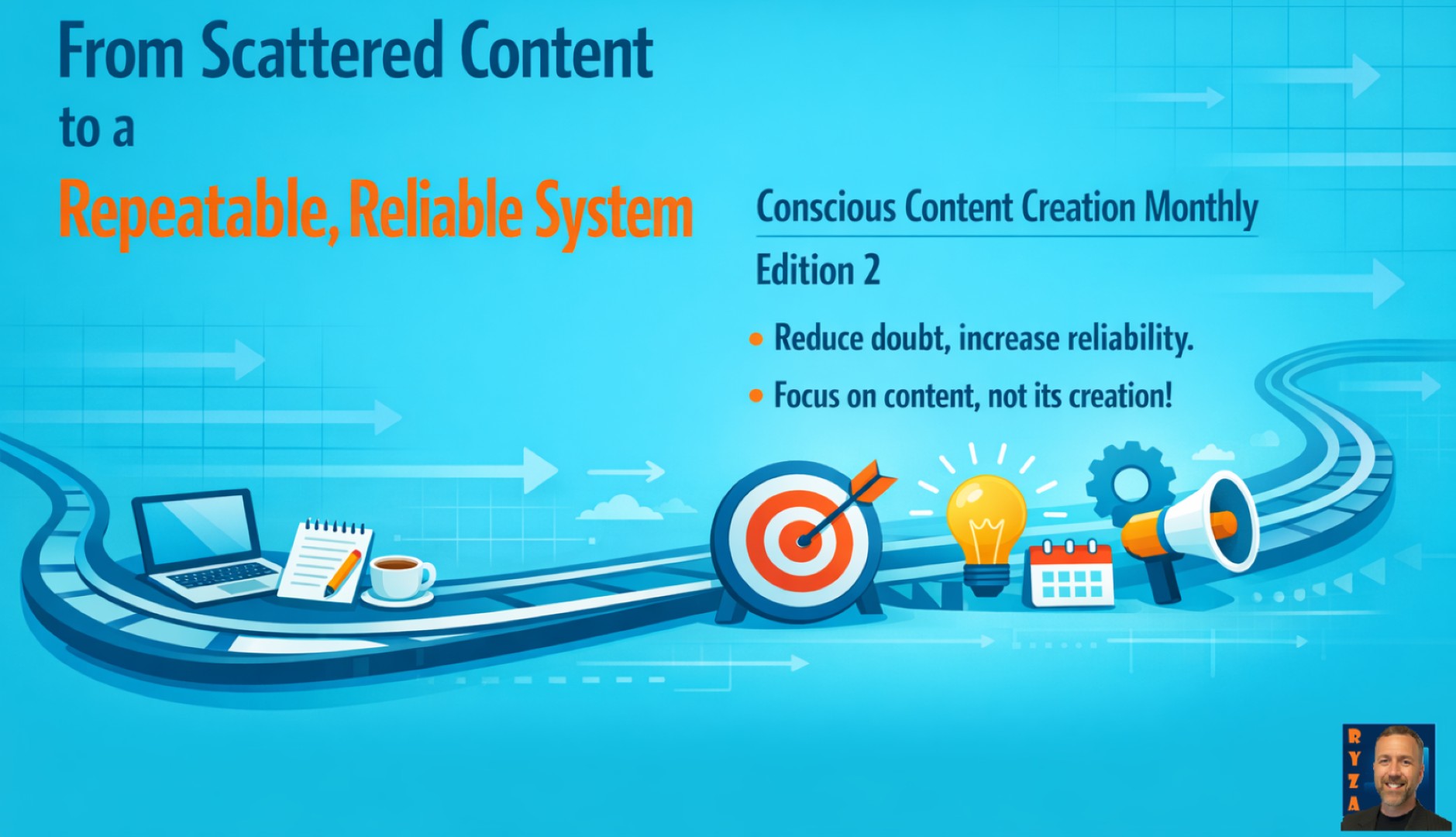
Ryza Content was created to solve these issues for individuals, influencers, and businesses. It is a system that acts like a high‑speed rail for your content: leaders focus on guiding direction, not laying tracks by hand.
Creating Conscious Content
The key ways to create content consciously and meaningfully are as follows:
- Treat content as a system, not a series of tasks: Map inputs, workflows, and approvals so that your tool can support each stage instead of acting as a last‑minute rescue function. This turns sporadic posts into a predictable publishing rhythm.
- Voice training is your brand insurance policy: The system should be fed with strong examples of past content, preferred phrases, and formats so AI collaboration enhances your tone instead of drifting from it. Daily creation limits then enforce quality over volume.
- Convert deep research into multi‑use assets: Utilize PDFs, images or reports with dense material to produce posts, newsletters, and summaries aligned with your existing voice. This lets subject‑matter experts stay focused on insight rather than rewriting and rehashing key points.
- Use AI to reduce leadership editing, not replace judgment: Create first drafts, options, and variations, then apply human review at key checkpoints. Leaders step in for decisions and nuance, not line‑by‑line cleanup.
- Protect ownership to enable bolder content: The system should not store generated content or infographics after processing; teams can work confidently with sensitive ideas and ICP detail without risking unwarranted exposure. Clear boundaries support faster approval for thought leadership.
Why a Content System Matters
Inconsistent, ad‑hoc content creation quietly erodes trust in your brand and wastes leadership cycles. When every post requires a heroic effort, the default becomes silence or generic messaging that sounds like everyone else. A structured AI‑collaborative workflow lets you publish often without diluting your identity.
By training the model on past content and enforcing limits, you keep a stable voice while scaling production. Content ownership and non‑storage reduce internal resistance around risk and compliance, which speeds real adoption. The practical outcome is simple: more relevant content, created faster, with fewer revision loops.
Actionable Insights
- Audit your current content flow. List how ideas become posts today, from research to approval. Identify where work stalls or bounces between teams; those are prime spots to introduce a content creation system (like Ryza Content ).
- Curate a “voice canon” for training. Select your best newsletters, posts, and marketing content that feel unmistakably like you. Use these as the base for voice training so the system learns style, tone, and structure.
- Standardize a weekly content cadence. Define realistic volumes per channel and enforce them with daily creation limits. This keeps output consistent without pushing your teams into low‑quality production.
- Turn raw research into a content queue. Feed PDFs, images, or reports into the system and specify target formats like LinkedIn posts or email briefings. Review and lightly edit the outputs, then schedule across your channels.
- Build a lightweight review framework. Decide which content types need leadership sign‑off versus team‑level approval. Use the system for first drafts and constrain leadership involvement to high‑impact pieces and final checks.
- Separate “explore” from “publish.” Use your AI-collaborative system to generate variations and experiments in a sandbox, then select only the strongest for your live calendar. This protects your feeds while letting teams test new angles.
- Align AI usage with compliance expectations. Document that generated content and ICP lists are not stored and remain user‑owned. Share this with legal and security stakeholders to reduce friction and enable broader rollout.
Metric to Watch
Content revision cycles per asset. Track how many times a draft bounces between creator, reviewers, and leadership before publishing. When a well-organized content system like Ryza is trained on your voice and workflows, that number should fall, signaling tighter alignment and less rework. If cycles increase, revisit your voice canon, prompts, and where human review happens.
Recent Use Case
Last month, a small leadership team faced an issue with consistent content creation across their social media channels. Their experts had strong insights but struggled to convert dense research and PDFs into regular, clear content. Social channels went quiet for weeks, then surged with rushed posts that did not quite sound like them. Executives were pulled into heavy editing, which slowed everything further.
At Ryza, we recognize this as a common issue, and offered to provide them with White-Glove services for their LinkedIn Business page. We began by assembling a small library of past posts, company blogs, and newsletters that felt “on brand.” This voice canon fed Ryza’s training. Next, we defined a simple cadence across LinkedIn and social media within the existing daily creation limits to avoid flooding channels with thin content. Their research reports and internal PDFs were routed into Ryza to generate structured post series and segments.
Within just 3 weeks, the company found that their subject‑matter experts spent more time refining ideas and less time wrestling with draft wording. Leadership touched fewer pieces directly, focusing only on key narratives. Content ownership and non‑storage addressed internal concerns around sensitive material. The result is that now the company has a consistent, professional brand presence across their channels, created with a fraction of the previous friction.
TLDR
Leaders do not need more content ideas. They need a system that turns existing expertise into consistent, trusted communication. When AI works inside clear guardrails and respects ownership, it becomes a partner, not a risk. The next step is not more channels or more volume, but a sharper, more intentional content engine that your teams can actually maintain.
Explore Ryza Content Strategically
If you want your content process to feel like a high‑speed rail instead of a manual track build, explore how Ryza Content can structure your team’s workflow and protect your voice. Share this issue with your marketing and content leads, then shortlist one campaign to pilot an AI‑collaborative approach.
You can find us on LinkedIn or visit our website at www.ryzacontent.com or send us a DM Timothy Goebel or Dr. Kruti Lehenbauer to see a demo or set up a time to get personal insights into your own content creation needs!